
 Contact us

March 5,2026
AI Optimisation: An in-depth guide to AEO, LLMO, and GEO

Key Highlights of AI Optimisation
- AI optimisation is a digital process that requires websites to be read and understood by AI models. If the content on your site is optimised, AI may quote, reference and link back to your website.
- AI optimisation is less about the guarantee of getting your content used by AI and more about positioning your content in a way that increases the likelihood of that happening. The goal is to ensure your website is visible, credible, and well-represented across trusted sources
- AEO (Answer Engine Optimisation) is the practice of optimising your content to be easily extracted, and summarised to specifically be used as the direct answer, featured snippet or summary by answer engines.
- GEO (Generative Engine Optimisation) is the practice of improving your content to be more in-depth so AI platforms can easily pull your content into their answers as the chosen source
- LLMO (Large Language Model Optimisation) is the process of creating and structuring your content so that AI models are more likely to reference your business, and recommend your brand.
- GEO works better for larger more in-depth topics that require more comprehensive answers, AEO is used more commonly for shorter, direct answers
- AI doesn’t recall knowledge like a person would, it’s predicting, and randomly generating the most likely answer and presenting it in a way that feels ‘natural’ and ‘informed’.
- AI optimisation is not a replacement for SEO. It’s an extension of it.
The way people find information is changing quickly. Not only are they looking through search results, (which now include things like AI overviews for searches), people are now asking AI tools direct questions. Whether it’s recommendations, comparisons, or explanations, AI is now part of the consumers decision making process and the brands and businesses that get mentioned are the ones they are more likely to trust.
The goal of AI optimisation is to ensure your business and content are visible, credible, and well-represented across trusted sources, increasing the likelihood that AI systems will select and reference you in their responses.
This article looks into what AI optimisation is, how search behaviour is evolving, what AI models actually look for when choosing which businesses to mention, and the practical optimisation strategies for;
- How does AI choose its answers?
- The challenge of AI optimisation
- AEO (Answer Engine Optimisation)
- GEO (Generative Answer Optimisation)
- LLMO (Large Language Model Optimisation)
What is AI Optimisation?
AI optimisation is a digital process that ensures websites can be read and understood by AI models. If the content on your site is optimised, AI may quote, reference and link back to your website.
To optimise your website, there are a range of areas that businesses need to review, such as:
- Content optimisation
- Page structure
- Schema markups
- Online reputation
- Brand mentions and backlinks
You may have noticed that a lot of the areas recommended to review are areas that, with a good SEO strategy, you will be optimising anyway. While it’s true that there are similarities between optimising your site for AI and SEO, the main difference is the reason why these areas are updated.
SEO focuses on getting you ranked high in search engines.
AIO (AI optimisation) is the strategy behind getting your content to appear in AI responses.
So, why is it important to start looking into this?
The way we search is shifting
For years, the focus on how and why we optimise websites has been to get your website to rank in search engine results and gain clicks through to your website.
However, in recent years, the shift has started to move towards AI – the way that we now search is dramatically changing, and zero-’click’ results are becoming more and more prevalent.
Zero click search occurs when: a user finds the answer to their query without needing to go through to a website.
As an example, lets say someone searches in Google ‘What is AI optimisation’, the search results will show a list of links to websites, these can come in a variety of formats such as; link, video, image. Now they also have AI overviews.
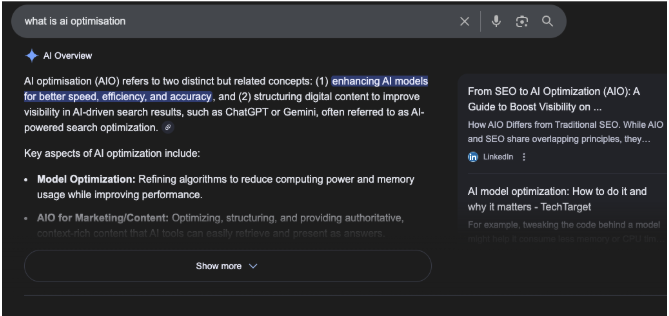
AI overviews are quick concise answers that LLMs (Large Language Models) cite from different sources – websites and articles.
One study found that ‘if a page loads within 1-3 seconds, the bounce rate is around 7%, at 5 seconds, it jumps to 38%’. This is because people want answers quickly. The introduction of AI now removes the amount of effort needed to search. The reason this is so significant is because AI is getting the data from trusted sources, condensing and summarising the content to give people what they are looking for in the search results.
This means that there is no need to go through to websites to get the information. AI simplifies the process of getting the answers people are searching for so why would they need to visit a website directly?
This is why optimising your website for AI has recently become such a talking point.
How does AI choose its answers?
The process is fairly straightforward. LLMs use a combination of the answering abilities of large language models with up-to-date information from the web. The system evaluates factors like content quality, relevance, and authority, then selects the most accurate and useful answer.
To do this, AI models may break the original query searched into smaller sub-questions, run multiple searches, and then piece together the most relevant information to form a final response.
How AI systems generate answers to questions
AI systems, ‘choose’ based on a few different areas. Here’s how it works…
- Before generating an answer, AI will pull together a list of pages that are relevant to a topic.
- Pages will be scanned for content, but only a few will be selected.
- The decision on ‘who’ to use, will be based on content, authority, patterns, and repetition across all sources. For example, how many sources make one specific point based on the query, if authoritative sources are all saying the same thing, that will be taken as the most likely answer to the search/topic.
- During retrieval of information, AI systems will also expand questions out into various related topics. This is called ‘Query fan out’ – AI models identify supporting web pages on the topic, this is how they show a diverse list of links.
Something to consider is that AI systems don’t store facts the way a human brain does – they don’t understand information how we do. Instead, they analyse patterns in the data they were trained on and use that data to predict the most likely response to a given prompt using information from the web.
AI isn’t recalling knowledge like a person would, it’s generating the most likely answer and presenting it in a way that feels ‘natural’ and ‘informed’.
The challenge of AI optimisation
It all sounds easy.
All you need to do is optimise your content and you’ll be used by AI, right?
The challenge however, is that there is no actual guarantee that you will be chosen, it’s difficult to track and each search in AI will generally bring up different results from one search to another.
As an example, we wanted to test the results for a question by asking about one of our clients’ websites.
Hoo Zoo and Dinosaur world are ranked as the #2 Best Zoo in the UK, on Trip Advisor.
We wanted to see how it was ranked in AI, and our search was surprising.
Our Process
Two of us in the office both opened;
- New conversation in Gemini
- A new incognito tab
We then both ran the same query in Gemini and on a Google Search: ’What are the UKs top 10 highest rated zoos in the UK?’
Our Results
With two people running this and in two separate systems run by Google, you’d expect a fairly similar result over both. Below are the answers from the Google Searches AI mode.
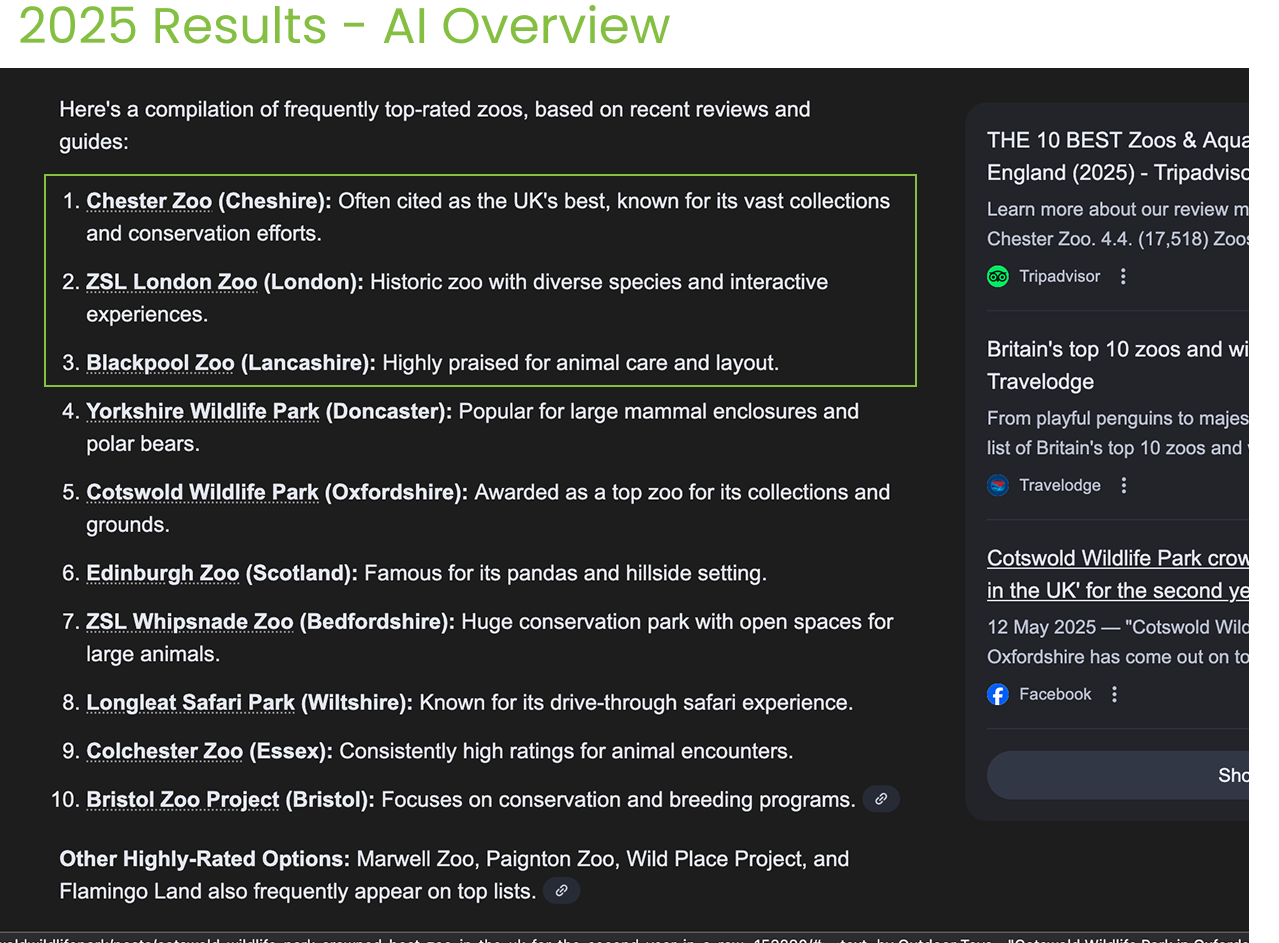
As you can see in the image above, in December 2025 Hoo Zoo did not make the cut. It was the same when searching in Gemini, there was no sign of Hoo Zoo in any of the rankings (See below).
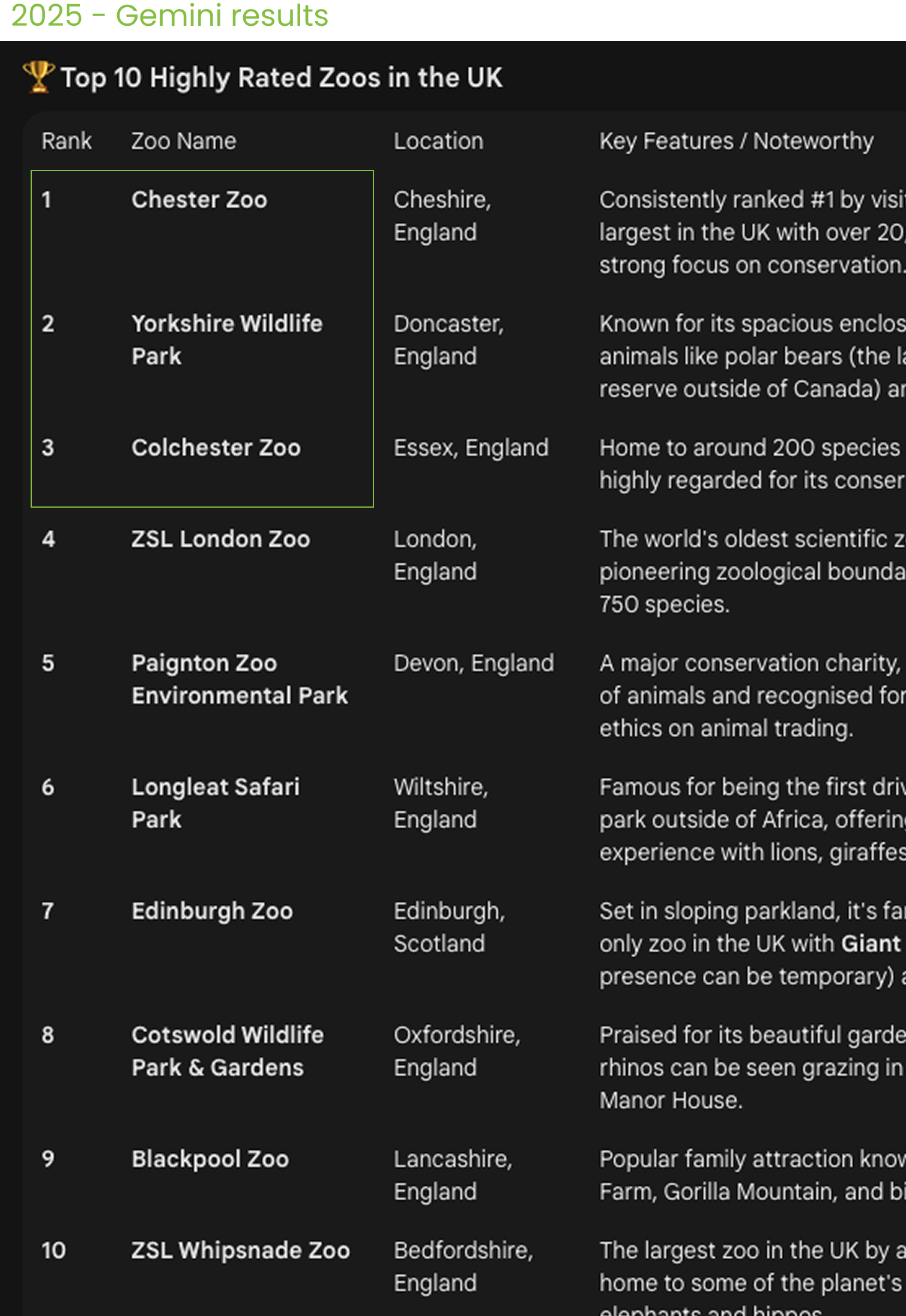
What was also surprising, was that we had differing results between all four results (two in Gemini, two in Google’s AI mode).
Though there were similarities between all the results, with some Zoo’s making all four lists, none were identical. The lists didn’t contain all the same zoos and the ordering was different in each case.
We conducted the same search 3 months later (20th February 2026), which showed slightly different results again, with Hoo Zoo now showing in the #2 spot.
We ran a similar test within the AI system to see if the same results would appear there as on the AI overviews.
We found that the results from Gemini to search differed.
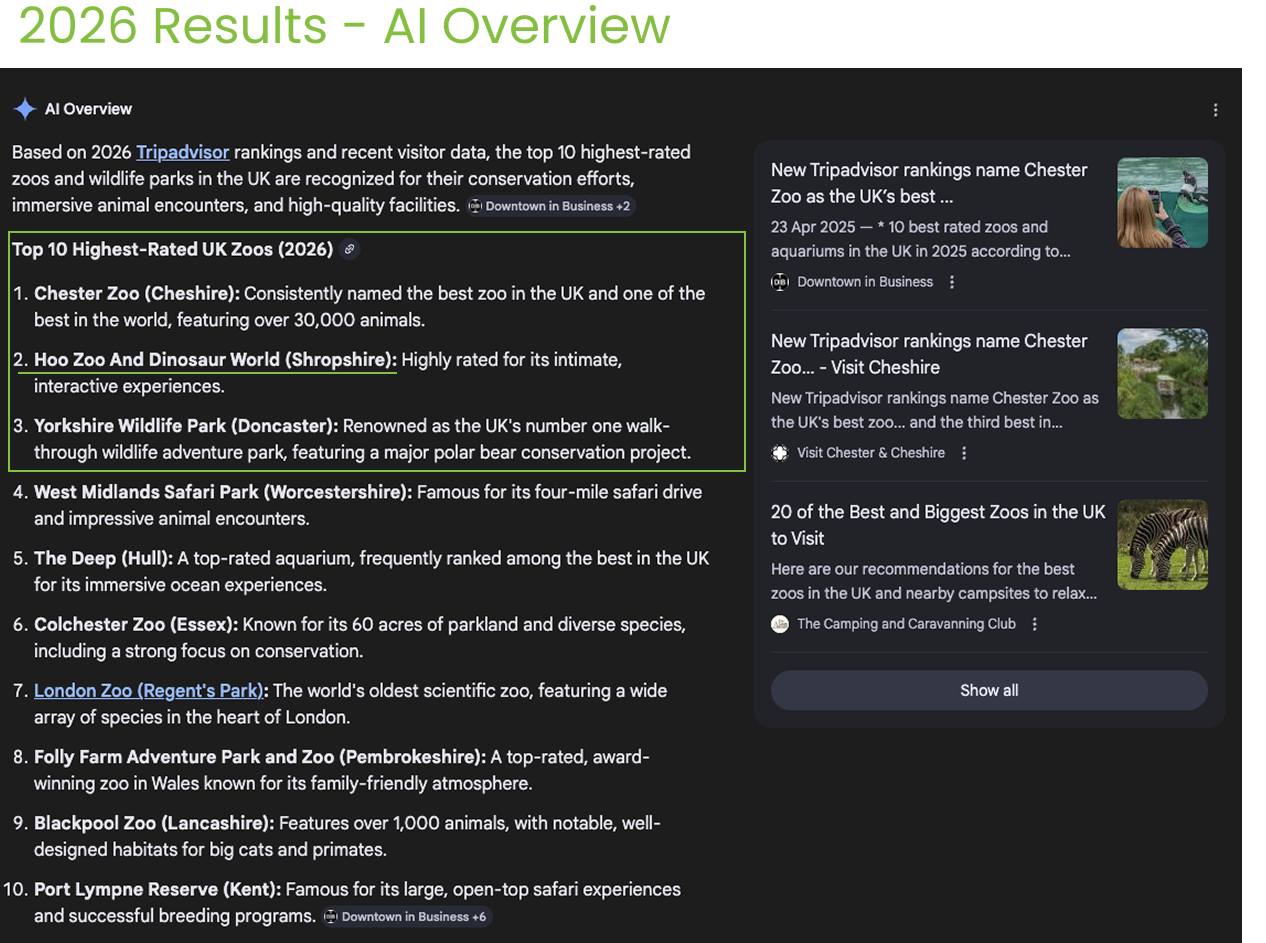
We did find one consistent each time we tested this. Chester Zoo was always at the top of the list, whereas the results underneath were more likely to vary.
What this admittedly, limited experiment demonstrates is that AI-generated results are not fixed or guaranteed. Unless an organisation has very strong media coverage or an established reputation, such as Chester Zoo in this case, it appearing in AI-generated answers may vary.
As we mentioned previously. ‘AI models may break the original query searched into smaller sub-questions, run multiple searches, and then piece together the most relevant information to form a final response’. Both times, we did the search AI analysed things like media coverage, rankings on sites like Trip Advisor. Whereas, during the most recent test, it also took into account unique experiences and value for money.
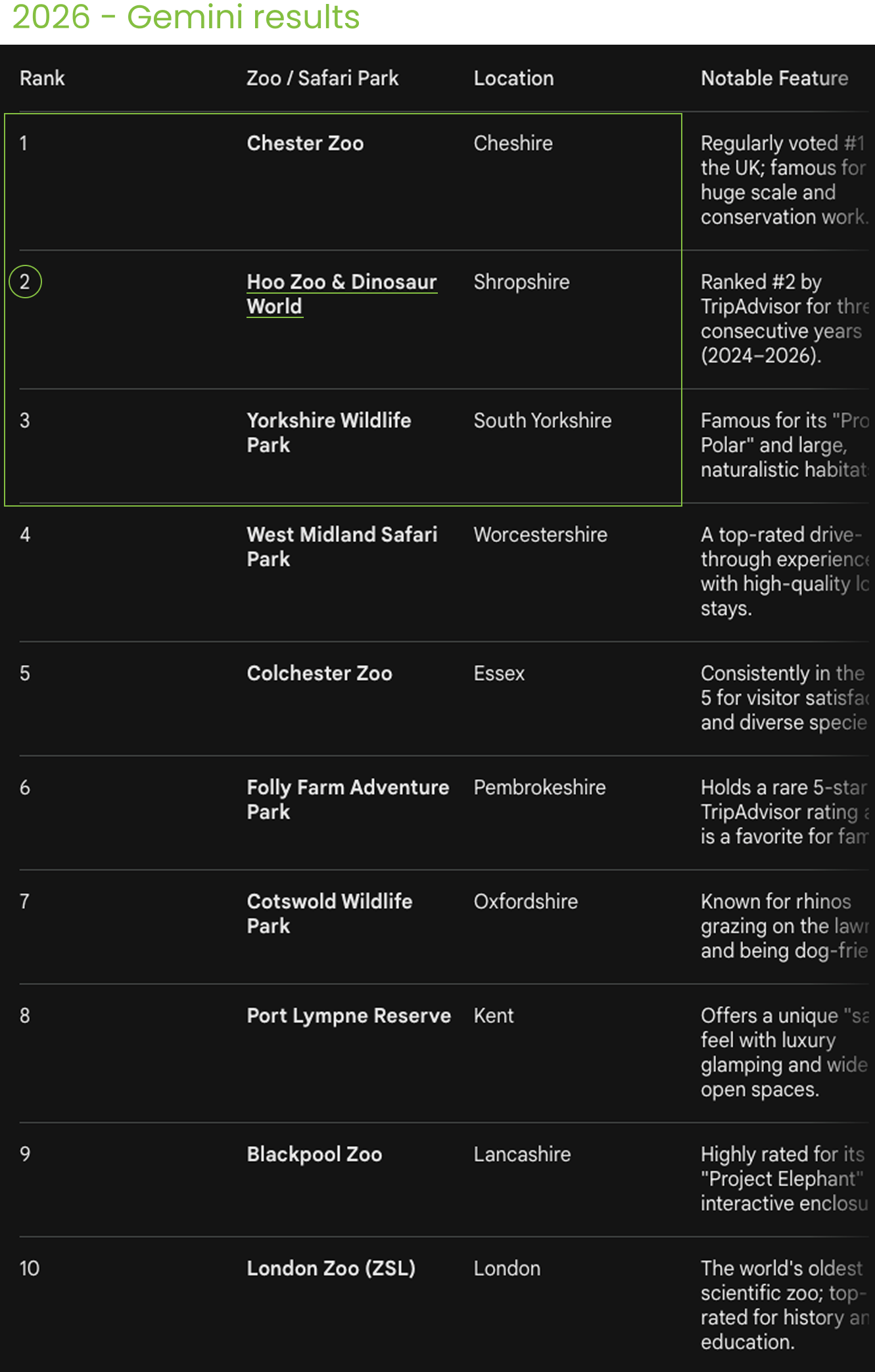
It valued Hoo Zoo higher the second time we ran the test because of media coverage, and it seems to be placing greater emphasis on the ratings from Tripadvisor, which ranks Hoo Zoo at the #2 spot.
What we learned
When it comes to getting your content chosen by AI, the process will be on-going. The way it chooses how it answers a question, and who it shows can differ each time you ask and from person to person. This article does a more in depth study around recommending kitchen knives, showing that the suggestions vary, with no definitive answer, describing AI as a ‘probability spicy auto complete’.
They do not log a single stored answer, but instead predict the most likely and relevant response based on patterns from available information.
With this in mind, AI optimisation might sound like an uncertain pursuit and there is no guarantee that you will be cited.
Though true (to a certain degree), this is where a change in perspective comes in, it is less about guaranteeing your place and more about positioning yourself.
The goal of AI optimisation is to ensure your business and content are visible, credible, and well-represented across trusted sources, increasing the likelihood that AI systems will select and reference you in their responses.
Traditional SEO and AI optimisation
Core strategies for AI optimisation, are not entirely new, or all that different from SEO (Search Engine Optimisation), in fact many of the practices that you do for SEO are the same.
- Content optimisation
- Page structure
- Trust signals
- Schema markup
- Keeping your website up to date
- Pushing backlinks and brand mentions
These are all efforts that we already do for SEO, but now the goal has shifted.
With SEO, good strategies result in higher ranks and more traffic to your site.
With AI Optimisation, the goal shifts, instead of focusing purely on clicks, the aim is to have your content selected, trusted, and cited by AI systems when they ‘generate’ answers.
The good news is, good SEO practices should result in high rankings and steady clickthrough rates, and these results will also help to boost the likelihood of your content being used by AI, as they improve things like authority and relevance.
In other words, AI optimisation is not a replacement for SEO. It’s more of an extension of it.
Why are AEO, GEO and LLMO important?
With more search shifting towards AI systems, more work needs to be done to get found online. People are no longer searching for answers in the way we are used to, instead that has shifted.
- ‘Zero click’ searches – Optimising your content means you increase the chances of being featured by AI
- Trust signals – Being featured by AI now works as a trust signal in and of itself.
- Visibility – Getting featured by AI increases your website visibility making your more likely to get found online.
- Future proof your site – with how integrated AI has become within search and everyday life, positioning your website for AI now is more important than ever.
- Purchase decisions – When people are close to purchasing, they now often ask AI for advice: which provider to choose, which product performs better, or what alternatives exist. These answers can directly elevate or exclude certain brands.
What is the difference between AEO, GEO and LLMO?
As there is a lot of overlap about how to optimise for each of these, they are often confused with one another. Despite this, there are key differences between the three;
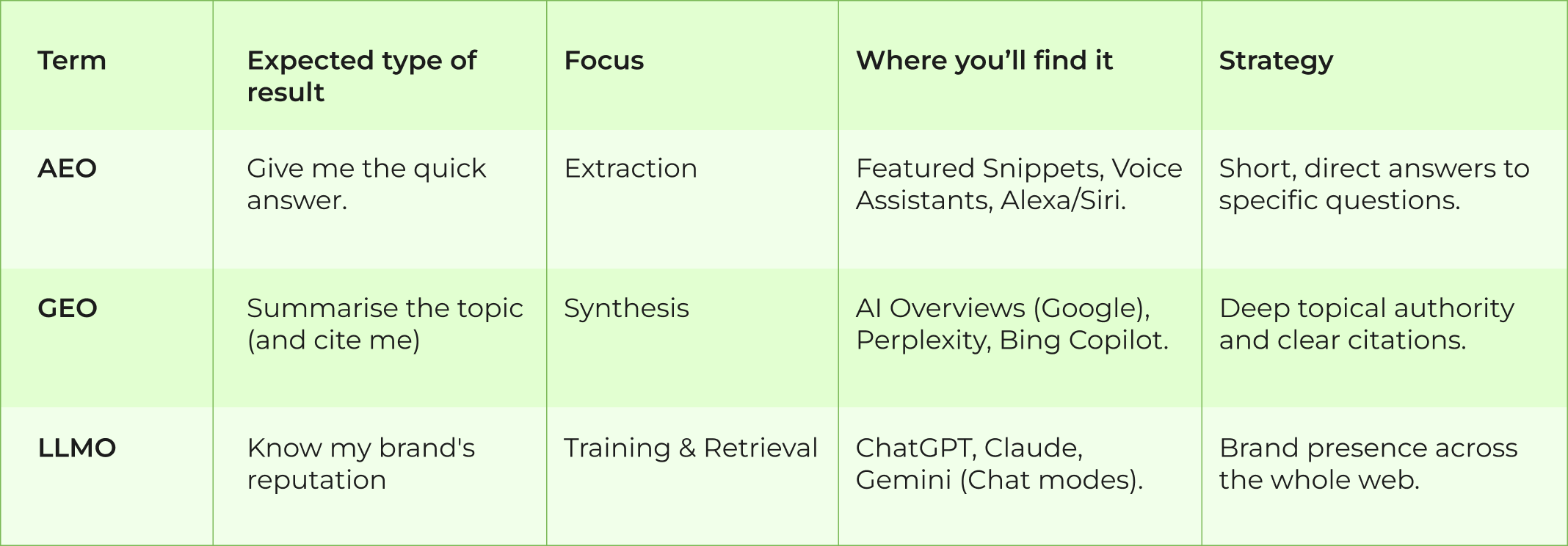
To summarise…
- AEO – Gives you a quick answer in AI overviews
- GEO – Summarises a topic and cites web pages in Google, AI overviews, generative chat bots
- LLMO – Knows and recommends your brand within Generative chat bots like ChatGPT, Gemini or Perplexity
What is AEO?
AEO stands for ‘Answer Engine Optimisation’.
It’s a strategy that focuses on optimising your content to include answers and summaries to be easily extracted, summarised, and cited by AI. Specifically for Google AI Overviews or Bings Copilot in search results.
See a more detailed explanation on What AEO is here.
Where might you find AEO results?
AEO results provide direct answers to questions rather than a list of links. You will see these as the featured snippets or answers within traditional search. Good AEO means your content is easy for AI tools to find and use as quick direct answers.
One study notes that ‘AEO focuses on optimizing existing content to be surfaced directly within the answer.’ You will mostly find AEO results within AI overviews, as the direct summary at the top of a search result.
For example…
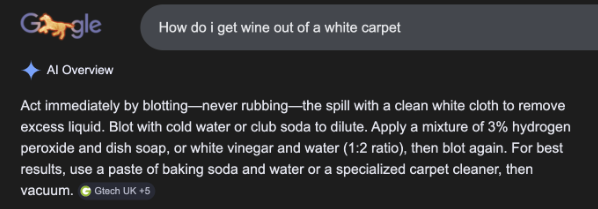
This AI overview gives a simple, summarised answer to my question within a traditional search.
You may also find AEO results within ‘People also ask’ answers, as one study found that the percentage of these answers that are AI are growing.
Key optimisations of AEO
- Use structured content and schema markup – Implementing this helps AI quickly understand the meaning behind a section, or page. It tells search engines, “this section is a FAQs”. And a logical flow will make your site more scannable.
- Keep your website up-to-date – Keeping your content up-to-date is good for both SEO and AEO, and it also builds trust with the real people reading your site.
- Trust signals – AI won’t pull information from a website that is vague, anonymous, or unreliable, and neither will humans. So, your site needs visible trust signals woven throughout your content.
- Direct Answers: Your content needs to provide answers early on. Try: starting blogs with direct statements, use simple explanations, use question focused headings, and use short punchy summaries. AI will cite clear and concise answers over long winded paragraphs.
- Write content for search intent: For AEO search intent is valued more than keywords. Consider and review whether your content actually answers the question behind different searches. In other words, does your article cover every question that might get asked around the overall topic?
- Conversational summaries: Conversational summaries give readers a quick overview of what a section, blog, or topic will cover, while the rest of the content provides the supporting detail. (See what we did there? That was a conversational summary.)
What is GEO?
GEO stands for ‘Generative Engine Optimisation.’
GEO is the practice behind how you can get AI to recognise and cite your content within AI generated responses that require more in-depth answers.
Where might you see GEO results?
You may see GEO results within
- Google AI Overviews
- AI platforms – ChatGPT, Gemini, Perplexity.
GEO helps your brand appear in any AI generated answer. If someone searches something, the response you get will evaluate brands and recommend options based on credibility and content depth. If your content appears in that response, providing more in depth information to a question, that is an example of GEO.
GEO is generally seen when users search topics that require more in-depth information. For example, ‘what makes a modern logo?’. The results that follow will typically be longform, articles, and topics that benefit from multiple perspectives.
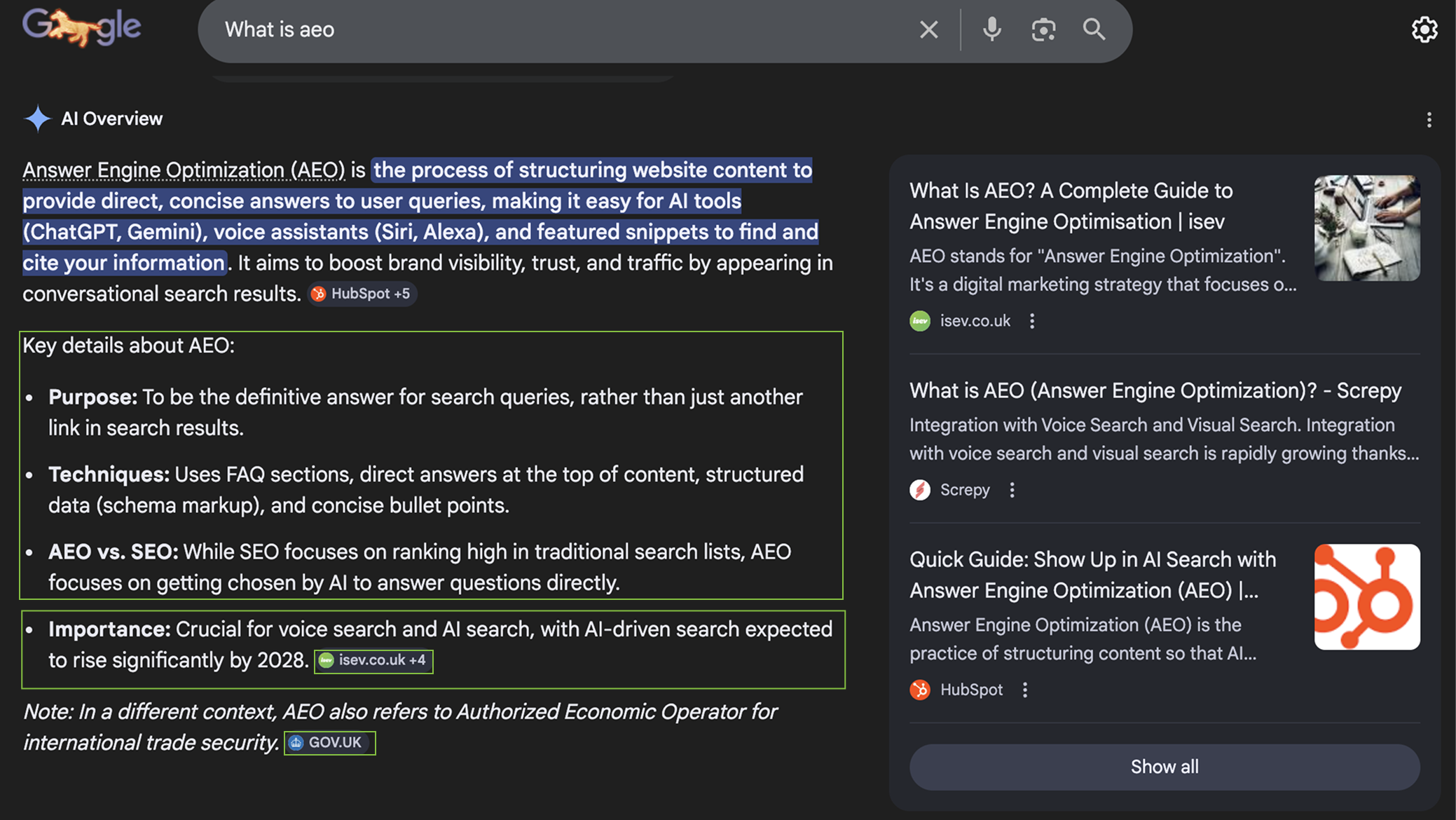
Heres what GEO results look like:
To show an example we searched ran a few searches
AI overview GEO results for (What is AEO)
Key optimisations of GEO
- Cover topics with depth: GEO prefers longform content that answers with depth. So, make sure that you fully explore the topics you write about.
- Structure content so it can be lifted: Content that is structured properly, with logical headings, shorter sections and clear topics is more likely to be lifted by AI.
- Schema Markup: Ensure that articles are marked up with schema, as this makes your content easier to interpret by AI models.
- Write content that sounds human: As Generative models are trained on human language, they generally tend to prefer content that sounds as if its ‘written like a person’. Vary sentence length, natural transitions, letting ideas flow rather than forcing ‘formulas’.
- Demonstrate expertise: do this by sharing original insights, credentials and include things like author bios and dates.
What is LLMO?
LLMO stands for ‘Large Language Model Optimisation.’
LLMs include AI models you’ll have heard of, such as ChatGPT, Gemini, or Claude.
LLMO is a more advanced approach to marketing that aims to influence the ‘output’ that LLMs like ChatGPT use. Similar to AEO and GEO its what you can do to influence these systems to cite and reference you, but in this case, its get specific brand mentions – LLMO has been successful if your brand gets mentioned and linked within AI chatbots, like Gemini, or ChatGPT.
Where might you find LLMO results?
LLMO results can be seen if your brand is mentioned and linked to within an AI chatbot. If someone searches a query in ChatGPT or Claude, your brand will be one of the sources that the model uses.
- ChatGPT
- Gemini
- Claude
This sort of results will appear for question like ‘What are the best mechanical keyboards for gaming in 2025?
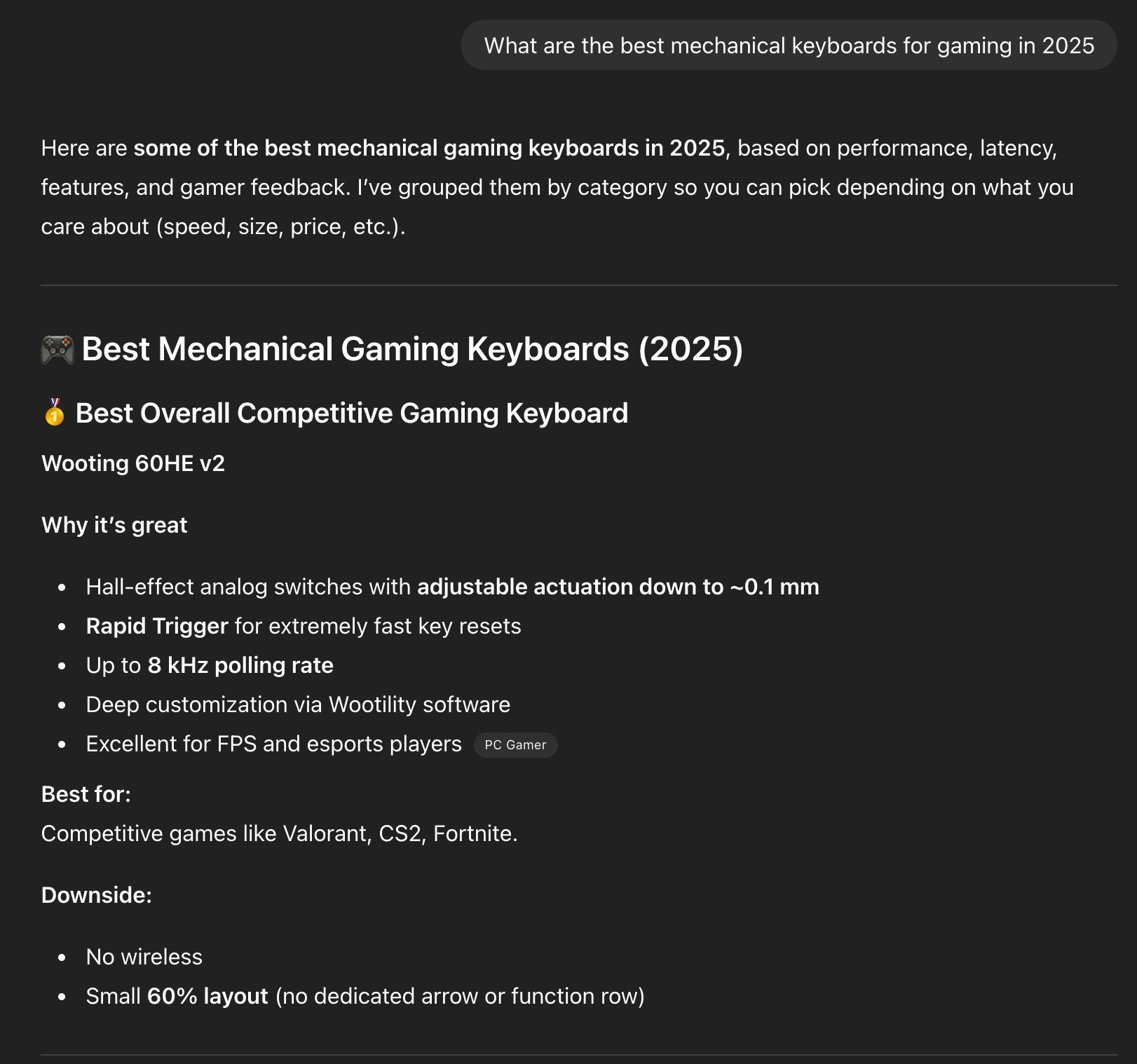
This question within chatGPT, pulls me a list of keyboards, with direct links to a range of different brands.
Key optimisations of LLMO
- Structure your content effectively: A good structure is more important now than ever because of how AI models read your site. They scan for signals, headings, topics and questions.
- Push brand mentions: Press and interaction is more important now than ever. As with SEO, LLMs value how your brand is spoken about, who its spoken about by and how often its interacted with.
- Provide complete context: Make sure that content has depth and isn’t vague. Give the full picture of who you are, what you do and why it matters.
- Build authoritative and factual content: Include data, statistics and case studies to back your claims throughout your site.
- Optimise meta data & other technical areas like schema: Technical elements like meta data, structured data (schema), and other on-page signals play a huge role in helping AI models interpret and use your content correctly.
Final thoughts
More people are asking AI tools questions and getting direct answers, without ever needing to directly visit the website(s) that the information is sourced from. Within those answers, AI is actively choosing which brands and businesses to cite and mention.
That means visibility isn’t just about ranking on search engines anymore. It’s about whether your business is recognised as a trusted, relevant source across the web.
The good news is that the foundations haven’t completely changed. A strong SEO strategy is still essential. But businesses now also need to think beyond rankings and also start focusing on content quality, clear website structure, brand mentions, PR coverage, and the overall authority of their sites.