
 Contact us

December 2,2025
What Is AEO? A Complete Guide to Answer Engine Optimisation

Key highlights on how to optimise your content for AEO
- Your content needs to be clear, structured, and relevant to be cited.
- Start sections with direct answers and focus on user intent, not just keywords.
- Use structured content, headings, and schema so AI can accurately interpret and extract your content.
- Bite-sized, conversational summaries at the start of sections make key points immediately accessible for AI and readers alike.
- Write self-contained paragraphs, use LLM-friendly formatting, and add short summaries to make your content instantly understandable.
- Keep your site up-to-date and include trust signals like author info, reviews, for clarity and transparency
When people use a search engine, like Google, to find information, there are a myriad of ways that information can be displayed; search results, map listings with local businesses, people also asked questions, videos, images and more.
Showing up in these generally all fell under the umbrella term of “SEO” (Search Engine Optimisation). More recently, there has been a new search engine feature that has been showing up – AI overviews, which are a whole different beast when trying to get shown in them.
While SEO focuses on helping your pages rank in search results, AEO (Answer Engine Optimisation) is about making your content ready for AI to find, understand, and confidently reference. It’s the process of optimising your content so AI tools like ChatGPT, Gemini, and other answer engines can pull your expertise directly into their answers, citing you as one of the sources of information.
Answer engines aim to give users a direct answer to their questions. They summarise, extract, and cite content from multiple sources.
AEO isn’t just a technical exercise, it’s a strategic approach to connecting with users where they already are, and people are now relying on AI to get instant answers.
In this article:
Learn what AEO is, the risks that come with it as well as why its so important.
- What is AEO?
- How do answer engines work?
- Why are answer engines important?
- User intent & AEO
- How to optimise your content for answer engines
What is AEO?
AEO stands for ‘Answer Engine Optimisation’.
AEO is a digital marketing strategy that focuses on optimising your content to be easily extracted, summarised, and cited by AI and search features. It’s how to optimise your content so that AI tools can find it and use it as a direct answer for a query or search.
Instead of competing for a place in search results, AEO focuses on optimising your content so that it might get cited in AI answers, offering instant answers to to clients
How answer engines work
The first steps in being cited by AI tools is to understand how they work and the key differences between how search engines and AI view and use your content, firstly;
AI values user intent: Traditional search engines match keywords and topics, while answer engines focus on the intent behind the question.
AI Scans for Clear, Direct, Extractable Information: They will select content that is straightforward, factual and ‘logically structured’.
How does AI choose Answers to queries?
When it comes to understanding how answer engines find responses, the process is fairly straightforward. They combine the reasoning abilities of large language models with up-to-date information from the web. The system evaluates factors like content quality, relevance, and authority, then selects the most accurate and useful answer.
To do this, the AI may break your original query into smaller sub-questions, run multiple searches, and then piece together the most relevant information to form a final response.
Keep in mind that AI systems don’t store facts the way a human brain does, and they don’t understand information in a conscious sense. Instead, they analyse patterns in the data they were trained on and use that data to predict the most likely response to a given prompt.
AI isn’t recalling knowledge, it’s generating the most statistically likely answer and presenting it in a way that feels ‘natural’ and ‘informed’.
What’s the difference between an Answer Engine and a Search Engine?
The main difference between the two is how they act within a search.
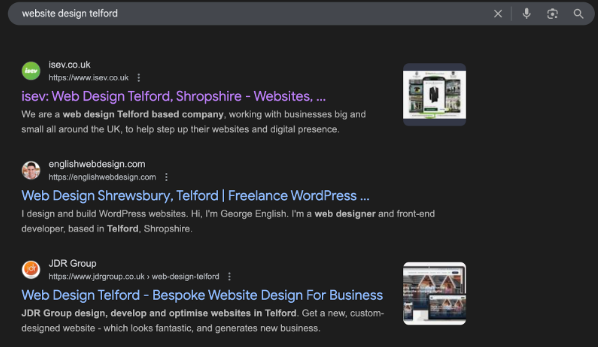
A search engine will present a search with a range of sources relevant to the keywords used.
For example, ‘Web Design Telford’ presents a range of results, of different websites relevant to that search term.
On the other hand, an answer engine uses AI to gather an answer to the search query. If you search ‘difference between a search engine and answer engine’, for example, you’ll find the first result is an answer to that question, with links to sources and key points relevant to that query.
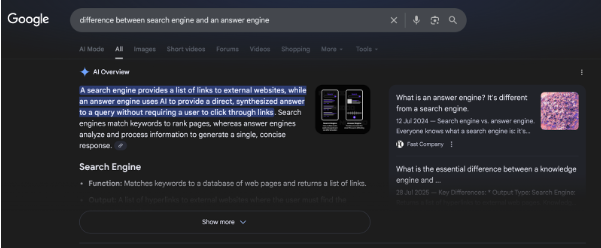
Search engines: Matches keywords of a search to a range of webpages and presents you with a range of links. This requires the user to click on links that are relevant to what they search.
Answer engines: Uses AI to give a direct answer to the person’s search/query. It aims to give a single answer without the need for more interaction, and often links to where it has gathered its data from.
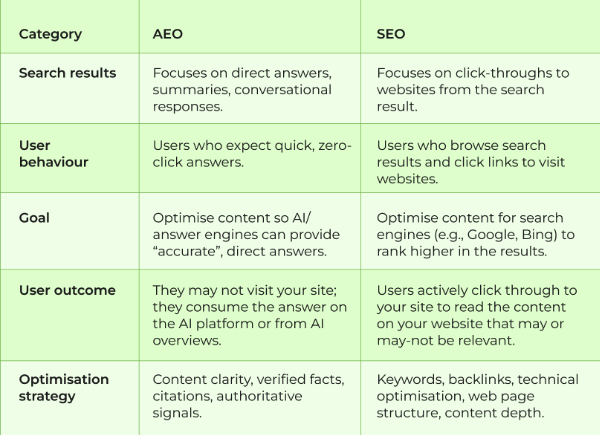
So, now you know what the two are, you might be wondering how does SEO (search engine optimisation) differ from AEO (answer engine optimisation)?
AEO is not perfect – and there’s still much we don’t know
While answer engine optimisation can be a great way to get AI to understand and share your content, there are a few things to watch out for and keep in mind.
AI can sometimes ‘make things up’: Sometimes AI gives confident answers that aren’t actually true. This is called ‘AI hallucination’, and it can lead to wrong facts about the query, business, products, or content being shared with users.
As an example one study found that AI had been making up medical terms, and even human body parts. ‘AI identified an “old left basilar ganglia infarct,” referring to a purported part of the brain — “basilar ganglia” — that simply doesn’t exist in the human body.’
Misinterpretations: AI sometimes has an annoying habit being unable to read between the lines of what you’re asking.
Here for example, I searched ‘is firefox a panda’, I wanted to know if in the firefox logo the animal was a fox or a red panda. While I could have been more specific in my search, the (non AI) search engine results were accurate to what I wanted to know.
Most AI models default to interpreting a question literally unless there’s strong contextual evidence that the user means something else. Therefore, it states the obvious. “Firefox is not a panda, it’s a web browser”.

Thanks, AI overview.
Why is AEO so important?
With AI becoming more and more prevalent, search behaviour is now changing drastically. People aren’t just typing a search into Google and actively looking through the results, instead we now have AI overviews giving a direct answer. There are a range of AI tools to use like Google’s Gemini or OpenAI’s ChatGPT. In fact, most of the time now, people will get the answer they need without ever having to visit a website.
It’s not however, just about getting into the content that AI offers. It’s what this can bring to your business that makes it important. Take for example the fact that AEO can bring more purchase intent traffic to your website.
AEO not only helps to boost brand visibility but it also now acts as another trust signal, by showing your content to potential customers straight away, in a source that many users take their answers from without further research.
With the increase in AI, it’s now more important than ever to start optimising your content. Especially considering AI search tool reliability is predicted to increase by more than double over the next few years.
Understanding User intent & AEO
Before you get started looking at the best strategies for AEO, it’s important to understand User intent. This is the reason behind why someone searches for something online – the intent behind a search, in fact, the links/results that search engines provide are based on the user intent.
Understanding the intent of why someone is searching for something can be a massive benefit for any business when it comes to marketing.
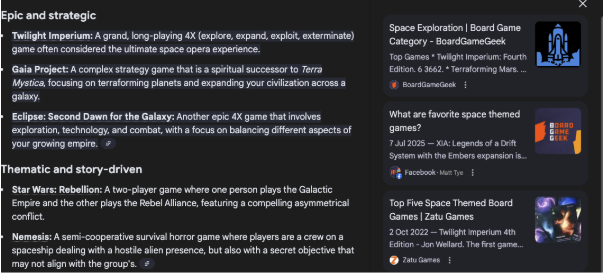
In a bit more detail, imagine someone searches “What are the best space-themed board games?” The user’s intent is clear: they want a list of high-quality, well-reviewed board games with a space theme. If your content focuses only on one specific game or one narrow sub-genre, it’s less likely to be selected by an answer engine as the main response to that query.
However, your content could still be used as a supporting piece. For example, if you’ve written an in-depth review of a single space-themed game, the system might instead pull your content as part of a broader answer effectively using your content to add detail or context within a larger list.
As you can see, for that same question, answer engines pull from a vast range of different sources.
Meeting that user intent is a crucial part of getting users or visitors to your website who convert.
Below are the four types of user intent…
- Transactional: This intent is when a user is ready to buy something. They would search knowing they intend to buy.
- Informational: This user wants to learn something about a topic – this intent is often met by informative blogs.
- Navigational: This intent is more specific, users will search for a specific website.
- Commercial: This intent is when someone wants to buy something but is still in the process of researching that product/service.
With this in mind, these are the types of searches you might see.
What are the best 4 player board games? – this person wants to know the best board games, they are probably either looking for information, and eventually, to make a purchase (Commercial)
Catan Amazon – This person probably wants to buy Catan, but specifically they want to buy them from Amazon. (Navigational)
How do I optimise content for answer engines – you are looking for information and an answer to this question, that might even be how you’re here. (Informational)
So how does user intent impact AEO?
If you want to optimise your content for AEO, the key part of that is to first understand your users’ intent.
To learn your user’s intent, here are a few options you can review…
- Look at analytics – are there any articles or pages that are predominantly landed on on your website? Analyse your users behaviour, such as click paths and time spent on pages.
- Review the top search results for a query. Google bases its results on user intent, so it’s worth looking at the results, and optimising your content for this.
- Direct user research – talk to your customers, get some feedback, the best way to learn what your users intent is, is to go straight to the source.
When it comes to AI overviews and the like, when people search they want instant answers. Taking a moment to understand the intent behind the questions they ask could be the difference between that customer converting or not.
Not to mention the fact that, if your content doesn’t match similar to the answer that a user is looking for then your content is less likely to get ‘picked’ by AI tools. And answer engines aim to provide the answer for what the user wants to know.
Consider how people phrase questions that AEs provide answers for.
- What is…
- What’s the best…
- Best tools for…
- How to…
When it comes to AEs, then intent behind the searches is generally informational, however this may vary depending on your business and the types of searches that you get ranked for.
How to Optimise your content for Answer engines
Now that answer engines are becoming a bigger part of how users search and find information online, it’s more important than ever to start optimising your content to be ‘ai ready’. This is all about creating clear, trustworthy content that AI tools can confidently use to generate their answers to common queries.
Start with direct answers
Take some time to review your content. If your content forces visitors to ‘dig around’ to find answers to their questions, then you may find it difficult to get on answer engines. Answer engines prefer content where the key message is ‘upfront’ and ‘unmistakable’.
AI tools skim your content quickly. If you don’t clearly state the answer early, the AI might skip over your content or misunderstand what you’re trying to say.
What to do
- Consider starting blogs or sections with direct statements.
- Use simple explanations first, details second. Give the quick version, then expand.
- When writing content, use question-style headings. For example “How much does web design cost?”.
Another tip is to create short, punchy summaries. These are easier to quote.
Clear, concise answers make your content answer-engine-friendly.
Write content for Search Intent, not just Keywords
For years, SEO was obsessed with keywords. Sprinkle them in the right spots, repeat them enough times, and you’d usually rank. But AEO has flipped that on its head. Answer engines don’t care how many times you optimise for keywords, they care whether you’ve actually answered the question behind the search.
This is where search intent becomes everything.
Think about it like this:
If someone types “how to grow my profile on TikTok in 2024,” they’re not looking for a blog that simply echoes the phrase back at them. Instead they may also want to know…
- What’s working on the platform right now
- Which types of content perform best
- How often they should post
- What mistakes slow growth
- Whether they need expensive gear
- They’re looking for guidance that feels practical and up-to-date.
In other words, they want all the things they were going to ask next without having to Google them.
Answer engines love it if your content provides information like this.
They don’t just look for the first sentence on the page; they look for content that covers the full journey of the question. Content that anticipates follow-up questions. Content that genuinely helps.
So when you’re writing or reviewing your pages, ask yourself:
- “If I were searching this, what am I really trying to find out?”
- “Have I answered that question directly?”
- “Have I given the next logical pieces of information someone would want?”
- “Does the content actually help someone do something or understand something?”
If the answer is yes, your content is already far more AEO-friendly than a lot of what’s published online. If not, then we’d recommend you take some time to optimise your content, and ensure that you are answering questions relevant to your content.
If you’re not sure on what questions come up, Google a topic you’re thinking of writing about and scroll down until you find a section that says ‘people also ask’. This can help give some ideas for content, but be sure to review their relevance.
Here’s an example of ‘people also asked’.
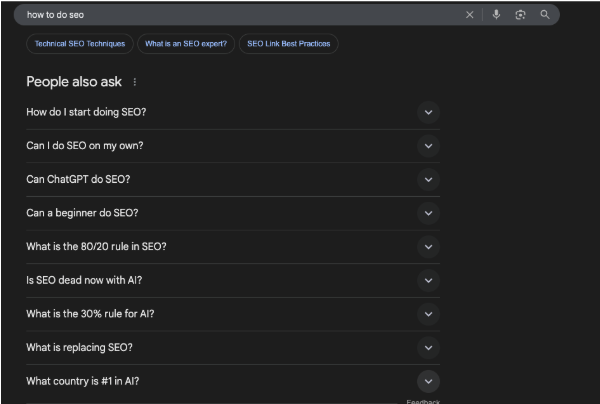
As you can see an article on how to do seo, could now be expanded into a range of topics, from 80/20 rules, to AI replacing it, and whether a beginner can do SEO and more.
Use Structured Content and Schema Markup
One of the biggest challenges with AEO is helping AI understand the meaning behind your content. Whereas we can look at a page and instantly recognise what’s a product, what’s a review etc. AI, however, needs a bit more help.
This is where structured content and schema markup can come in.
Think of a schema as a set of labels that help AI and search engines navigate the space. It tells search engines, “this section is a FAQs,” or “This bit is a customer review,”.
It doesn’t necessarily change anything visually on your site, users won’t see it. But answer engines rely on it heavily. Without these small cues, AI has to guess what your content means, and that’s when hallucinations or inaccuracies creep in.
Structured content also plays a huge role. Clear headings, a logical flow, scannable sections… all of these help AI understand the purpose of each part of the page.
So how do you actually put this into practice?
Start with the basics…
Before AI even gets to the schema layer, it needs to understand the shape of your content. Think of structured content as giving your pages a clear skeleton: the headings, the flow, the way you break information up, and how easy it is for both humans and AI to scan.
Many websites fail here, not because their information is bad, but because everything is buried in long paragraphs, unclear headings, or pages that try to say five things at once.
Answer engines don’t have time for that. They scan quickly, they look for patterns, and they try to understand what each section means.
This is why structured content is so powerful.
When your page has…
- a single clear topic
- logical, descriptive headings
- short paragraphs
- scannable sections
- clear definitions
You’re essentially guiding the AI through your content the same way you’d guide a reader: here’s what this section is about, here’s what you’ll learn next, here’s the context behind this idea.
The more organised your content is, the more confidently answer engines can reuse it.
Heres how you can structure content:
Use H1, H2, and H3 headings properly – Headings are signals AI uses to organise information. Make sure that your content uses hierarchy correctly. Learn more here.
Keep menus simple and logical – Don’t bury important pages five layers deep, you want pages to be easy to find and navigate to.
Break information into smaller sections – Walls of text confuse both people and AI.
Use short paragraphs and bullet points to break up text.
Keep your website fresh and up-to-date
While fresh content is favoured, outdated content will sometimes still be used if AI is trying to fill gaps.
This is where businesses can now run into trouble:
If your website still shows old services, past pricing, outdated stats, or blogs written for a version of your business that no longer exists or from a time in the industry that’s now changed, answer engines may pick up that information and present it as if it’s accurate today. Not because they want outdated data but because they have no way of knowing it’s outdated.
That’s why a little maintenance goes a long way.
You don’t need to constantly rewrite your entire site, but reviewing key pages every few months, refreshing older posts with new examples or updated figures, and making sure your contact or service information is correct can make a huge difference. Even small edits help signal to answer engines that your site is alive, active, and trustworthy.
Keeping your content up-to-date is good for both SEO and AEO, and it also builds trust with the real humans reading your site. And in a world where the internet acts as the middle layer between you and your audience, accuracy has never mattered more.
Heres what you should do to keep your content up to date:
Update key pages every few months. Even small tweaks count.
Refresh old blog posts – Add new examples, new data, better explanations.
Check that your details are consistent – Name, Address, Phone number is consistent across all platforms online – website, google business pages, directories etc.
Service information accuracy: Make sure product/service info is always accurate.
Build trust signals everywhere
If there’s one thing both answer engines and your audience will care about, it’s trust. AI doesn’t want to pull information from a website that is vague, anonymous, or unreliable, and neither do humans. When your content feels credible and clearly connected to real people, answer engines are more likely to use it.
To make that happen, your site needs visible trust signals woven throughout your content, little indicators that show who you are, what you know, and why someone should believe you.
One of the simplest ways to build trust is to make your content feel like it comes from a real person.
A few easy ways to do that:
- Add author names to guides, blogs, and resources.
- Share your background, qualifications, or hands-on knowledge when relevant. This can be done with logos, case studies and more.
Trust also comes from clarity. The more open and straightforward your website feels, the more dependable it appears.
Make sure you clearly explain your processes, timelines, or policies, and keep contact information easy to find (phone, email, location, social links).
When your site feels open and honest, answer engines see it as a safer source to quote.
All of this ties into what Google and other platforms call E-E-A-T – experience, expertise, authoritativeness, trust. In the world of AI-generated answers, E-E-A-T is becoming a deciding factor in whose content gets surfaced and repeated.
Strong trust signals = stronger chances of AI using your content accurately and prominently.
Heres what you can do to ensure your business is trustworthy
- Add author names to articles and guides
- Showcase reviews and testimonials.
- Add links to reputable sources when appropriate.
- Be transparent about pricing, policies, and processes.
- Keep contact information visible.
Create Content That Stands Alone
If there’s one thing most people don’t realise about answer engines, it’s this:
AI rarely reads your whole page.
Instead, it scans the structure, pulls out small chunks of text, and decides which individual paragraph best answers a question. That means every paragraph on your site is a potential “quote” an AI tool might lift and show to users, even if it was never meant to stand alone.
That’s why we can’t emphasise enough the importance of hierarchy, structure and more, and because of that, your content needs to make sense even when it’s taken completely out of context.
AI usually doesn’t read your entire page. It lifts small chunks of text and uses them as standalone answers.
Here’s how to write content that can be lifted, quoted, and reused without losing clarity:
Make each paragraph self-contained: Write in a way that someone could read just that one section and still understand the point.
Avoid references that depend on earlier text: Skip phrases like: As I mentioned above, like we discussed, see the section below…
AI won’t know what “above” or “below” is.
Define niche or technical terms as soon as you use them: If you drop jargon without explanation, AI may misinterpret it or skip the section entirely. Remember the key is to answer questions in the most clear and logical way.
You can still use jargon terms, but make sure theres enough context and explanation.
Use clear, complete sentences: Simple, readable writing is easier for both humans and AI to use.
Here’s a quick example using the jargon explanation to see how you could alter content.
Bad (relies on earlier context):
“As I explained earlier, don’t use too much jargon.”
Better (makes sense on its own):
“This step is crucial because if you use jargon without explanation, your audience may not understand it. Remember the key is to answer questions in the most clear and logical way.”
Conversational Content
One of the simplest yet most powerful ways to make your content answer-engine-friendly is to write it in a conversational way. Your content shouldn’t use a string of business jargon, instead it should sound like something your or I would say out loud.
Conversational content often uses words like, who, what, when, where, why or how, all of which tie in nicely to how answer engines ‘choose’ content. We recommend you still use keywords in your content, but do so in a way that directly addresses the question or problem your content is trying to solve and flows naturally.
Conversational summaries:
These are short, clear overviews of your content that both humans and AI can quickly understand.
Think of it as speaking directly to your audience. If someone asks a question and you immediately give them a helpful answer in plain language, they feel seen and understood. AI works the same way: it loves clear, concise, digestible summaries because they’re easy to quote and use in generated answers.
For example, Instead of diving straight into a 500-word explanation on email marketing strategies, instead try starting your section with something like:
“The key to a successful email campaign is to: know your audience, deliver valuable content, and stay consistent. These three steps make sure your messages get read, clicked, and users take action.”
This immediately gives both humans and AI the gist of what this article will say, while the rest of your content provides the detailed “how-to.”
Final thoughts
AEO isn’t just another marketing buzzword, it’s a fundamental shift in how content is discovered, interpreted, and shared online. As answer engines become the primary way people get information, businesses need to create content that is clear, structured, trustworthy, and genuinely helpful.
By focusing on things like user intent, offering direct answers, strengthening trust signals, and keeping content fresh, you give answer engines every reason to understand and cite your expertise.
Ultimately, AEO is about meeting users where they already are: looking for fast, reliable answers. When your content is built with that in mind, you’re not just optimising for machines — you’re providing a better experience for real people, too.